Strength training for beginners should start simple: two or three full-body sessions a week, light weights, perfect form and small, steady increases. Build flexibility, tendon and core strength first, then add load. This guide uses Tudor Bompa’s 5 basic laws and a simple starter workout from a San Diego trainer.
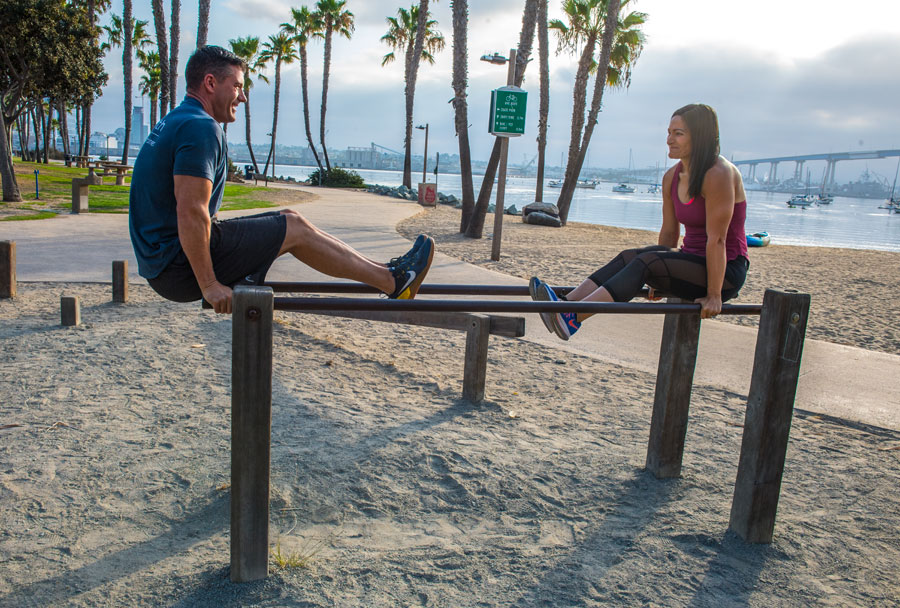
Walking into a gym for the first time can feel like showing up to a party where everyone else already knows the rules. There are machines with confusing diagrams, people grunting under barbells, and a hundred opinions online about what you “must” do.
But beginner strength training doesn’t need to be complicated. In fact, a handful of solid principles will take you further than any fancy program. And some of the best ones come from Dr. Tudor Bompa, the sports scientist widely known as the father of periodization.
So this guide covers how to start, what to do, and how Bompa’s five basic laws of strength training help you get stronger without getting hurt.
The quick answer: how should a beginner start strength training?
Train your whole body two to three times a week on non-consecutive days. Pick five or six basic exercises (a squat, a hinge, a push, a pull, a carry, and a core exercise), do one to three sets of 8 to 12 reps each, and use a weight that feels challenging but lets you keep clean form. Then add a little weight or a rep over time, as it gets easier.
That’s the whole recipe. The rest of this article explains why it works and how to do it well.
Why strength training for beginners is worth your time
Lifting isn’t just for people who want big muscles. Strength training helps you carry groceries, climb stairs, play with your kids, and get up off the floor without a struggle. It also supports bone density, joint health, and healthy blood sugar, and many people find it does wonders for their mood and confidence.
Public health guidelines in the U.S. recommend that adults do muscle-strengthening activities that work all the major muscle groups at least two days a week. So if you’re starting from zero, that’s a very reachable target.
Who is Tudor Bompa, and why should a beginner care?
Tudor Bompa is a Romanian-born sports scientist who developed the modern theory of periodization, the idea that training works best when it’s planned in phases instead of thrown together workout by workout. He has written a lot about training methods, and coaches around the world have built programs on his work.
His five basic laws of strength training were written with athletes in mind, especially young athletes who are just learning to train. That’s exactly why they’re so useful for beginners. They aren’t about lifting the most weight. Instead, they’re about building a body that can handle training for years.
The 5 basic laws of strength training
| Law | What it means in plain English |
|---|---|
| 1. Develop joint flexibility | Move through a full range of motion at your major joints |
| 2. Develop tendon strength | Give your tendons and ligaments time to catch up with your muscles |
| 3. Develop core strength | Build a strong trunk before chasing bigger arms and legs |
| 4. Develop the stabilizers | Strengthen the small muscles that keep your joints steady |
| 5. Train movements, not individual muscles | Practice patterns like squatting and pulling instead of isolating muscles |
For a deeper look at each one, read my guide to the 5 laws of strength training. Here’s how each one plays out for a beginner.
Law 1: Develop joint flexibility
Most strength exercises take your knees, hips, and ankles through a big range of motion. If a joint is stiff, your body finds a way around it, and that workaround usually shows up as strain or pain somewhere else.
Ankles are the classic example. If you can’t bring your knee over your toes because your ankle is tight (this is called dorsiflexion), your squat will lean forward, your heels will pop up, or your lower back will pick up the slack. That’s why Bompa specifically flags ankle flexibility as a priority for beginners.
What to do: Spend five to ten minutes before every workout on ankle rocks, hip openers, cat-cow, thoracic spine rotations, and a few slow bodyweight squats. Think of it as warming up your joints, not just your heart rate.
Law 2: Develop tendon strength
This is the law most beginners break. Muscles adapt to training faster than tendons and ligaments do. Around week three or four, you feel strong and want to add weight, but the connective tissue holding everything together hasn’t finished adapting. That mismatch is behind a lot of nagging elbow, knee, and shoulder pain.
Bompa calls the early stage of training “anatomical adaptation,” and it’s just what it sounds like: giving your body time to build a foundation before you push hard.
What to do: Spend your first four to six weeks on moderate weights, a controlled tempo, and stopping a couple of reps short of failure. Then progress gradually. For more on how to do that, read our guide to gradual progressive overload.
Law 3: Develop core strength
Bompa’s point is simple: your arms and legs are only as strong as the trunk they attach to. The core isn’t just your abs. It includes your abdominals, obliques, lower back, and the muscles around your hips and spine. It transfers force between your upper and lower body and keeps your spine steady when you lift, carry, or move.
Bompa recommends strengthening the core before focusing on the limbs. So in practice, core work belongs in every session, not as a throwaway finisher.
What to do: Start with dead bugs, bird dogs, planks, side planks, and loaded carries like farmer’s walks. These teach your trunk to brace and resist movement, which is what it does in real life. And no, you don’t need endless crunches.
Law 4: Develop the stabilizers
Every big movement has prime movers, the muscles doing the heavy lifting, and stabilizers, the smaller muscles that hold your joints in position so the big muscles can work. When stabilizers are weak, your body limits how hard the prime movers can fire, partly to protect you.
Think of the rotator cuff in your shoulder, the glute medius on the side of your hip, and the small muscles around your knees and ankles. They rarely get much attention. Still, they decide how solid you feel under load.
What to do: Add band external rotations, lateral band walks, single-leg exercises like split squats and step-ups, and Pallof presses to your routine. Unilateral work, meaning one arm or leg at a time, challenges stabilizers naturally.
Law 5: Train movements, not individual muscles
Bompa’s fifth law says to think in terms of movement, not body parts. In real life, and in sport, your muscles work together in chains. Training a movement teaches those muscles to cooperate, and that’s what makes you stronger in ways you can actually feel.
For a beginner, that makes programming a lot simpler. Instead of a separate day for biceps, you learn six patterns:
| Pattern | Beginner-friendly examples |
|---|---|
| Squat | Goblet squat, box squat |
| Hinge | Romanian deadlift, hip bridge |
| Push | Incline push-up, dumbbell press |
| Pull | Seated row, one-arm dumbbell row |
| Lunge / single-leg | Split squat, step-up |
| Carry | Farmer’s walk, suitcase carry |
Isolation exercises like curls and lateral raises aren’t off limits. They just belong after the foundational movements, not in place of them.
Strength training for beginners: a simple workout to start this week
Train three days a week, such as Monday, Wednesday, and Friday, alternating between Workout A and Workout B. Start with a five to ten minute warm-up from Law 1.
Workout A
| Exercise | Sets x reps | Bompa law it supports |
|---|---|---|
| Goblet squat | 3 x 8 to 10 | 1, 5 |
| Incline push-up or dumbbell press | 3 x 8 to 10 | 5 |
| Seated cable row or one-arm dumbbell row | 3 x 10 | 5 |
| Dead bug | 2 x 6 to 8 per side | 3 |
| Farmer’s walk | 3 x 30 to 40 seconds | 3, 4 |
Workout B
| Exercise | Sets x reps | Bompa law it supports |
|---|---|---|
| Romanian deadlift (light dumbbells) | 3 x 8 to 10 | 2, 5 |
| Split squat (hold a support if needed) | 2 x 8 per side | 4, 5 |
| Seated dumbbell overhead press | 2 x 8 to 10 | 5 |
| Lat pulldown or band pulldown | 3 x 10 | 5 |
| Side plank | 2 x 20 to 30 seconds per side | 3 |
| Band external rotation | 2 x 12 to 15 | 4 |
How heavy should the weight be? Pick a load where the last two reps of each set feel challenging, but you could still do two or three more with good form. If your technique falls apart, it’s too heavy. If you finish the set feeling like you could do ten more, go up slightly next time.
How do you progress? Once you can complete all your sets and reps with clean form, add a rep or a small amount of weight. Slow and steady wins.
How long until you see results?
Most beginners feel stronger within a few weeks. Much of that early gain comes from your nervous system learning to use your muscles more efficiently. That’s why you can get stronger before you look any different. Visible changes in muscle tone and size usually take a couple of months of consistent training, along with good nutrition and sleep.
Don’t forget recovery and food
Your muscles get stronger between workouts, not during them. Aim for seven to nine hours of sleep, at least one full rest day between lifting sessions, and enough protein, which for many people who lift regularly is roughly 0.7 to 1 gram per pound of body weight per day. You don’t need a perfect diet. You do need to eat enough to support your training.
Common beginner mistakes
Doing too much, too soon. Your enthusiasm is great. Your tendons just need a little more time than your motivation does.
Skipping the warm-up. It’s the cheapest injury insurance there is.
Chasing soreness. Feeling wrecked for days isn’t proof of a good workout. It’s often proof of a poor plan.
Only training the mirror muscles. Chest and arms are fun. Your back, hips, and core keep you healthy.
Changing the program every week. You need to repeat a workout enough times to get better at it. Consistency builds progress.
Ignoring pain signals. Muscle fatigue is normal. Sharp or pinching joint pain is your cue to stop and reassess.
Strength training for beginners in San Diego: start on the right foot
The best beginner program is the one that fits your body, schedule, and goals, and that you’ll actually stick with. At Chris Keith Personal Training in San Diego, we build every plan on solid fundamentals like the ones above: sound movement, gradual progression, and coaching that keeps you accountable.
So if you’d like help getting started, schedule a consultation, check out The Method, or see our rates.
This article is for general education and isn’t a substitute for personal medical advice. Talk with your doctor before starting a new exercise program, especially if you have an injury, a medical condition, or haven’t exercised in a long time. For more on Charles Poliquin
Related reading: progressive overload, the 5 laws of strength training and personal training for beginners in San Diego.
New to lifting and want a coach in your corner? Text Chris at (619) 840-9099 for a free consultation.
Frequently Asked Questions
Have a question that isn’t covered here? See the full personal training FAQ.
How many days a week should a beginner strength train?
Two to three days a week is a solid starting point. Full-body workouts on non-consecutive days give your muscles time to recover between sessions.
How many sets and reps should a beginner do?
Most beginners do well with one to three sets of 8 to 12 reps per exercise, using a weight that challenges them while keeping good form.
What are Tudor Bompa’s 5 basic laws of strength training?
They are: develop joint flexibility, develop tendon strength, develop core strength, develop the stabilizers, and train movements rather than individual muscles. Together, they help build strength while lowering injury risk.
Do beginners need to lift heavy weights?
No. Start with moderate weights and focus on technique. Your muscles, tendons, and joints need time to adapt before heavier loads make sense.
Is it better to start with machines or free weights?
Both work. Machines can feel more stable when you’re learning, while free weights and cables challenge balance and stabilizers. A mix of the two is a good approach.
Can I build strength at home?
Yes. Resistance bands, a pair of adjustable dumbbells, and a sturdy bench or chair are enough to cover the major movement patterns.
Is it normal to be sore after my first workouts?
Mild muscle soreness for a day or two is normal when you’re new. Sharp joint pain, swelling, or soreness that lasts several days is not, and it’s a sign to dial things back.
Do I need a personal trainer to start strength training for beginners?
You don’t need one. But a good trainer can teach proper technique, choose the right starting weights, and build a plan around your body and goals, which saves a lot of guesswork and helps you avoid early setbacks.
Chris Keith has over 30 years of personal training in San Diego (since 1995) and was voted Best Personal Trainer by San Diego Magazine. He trains clients one-on-one at his private studio in Bay Park / Morena. Learn more about Chris or contact Chris to get started.